

Businesses Brace for Slower Growth Despite Improving Demand for Additional Credit


Joel Mueller
Posted: August 13th, 2026
Businesses entered the third quarter of 2026 with increasingly mixed economic conditions. According to Barlow Research’s Third Quarter 2026 Economic Pulse Study, small businesses ($100K-<$10MM in annual sales) experienced weakening financial performance as rising operating costs and slowing customer demand placed greater pressure on their margins. In contrast, middle market companies ($10MM-<$500MM in annual sales) posted improved financial results driven by stronger sales, although elevated costs continued to weigh on profitability. Across both segments, businesses remain cautious about the year ahead, balancing selective growth opportunities with an increased focus on liquidity, working capital and disciplined financial management.
Small business outlook
Overall financial conditions weakened as small businesses reported softer sales, declining profitability and a sharp deterioration in excess cash reserves. Net difference overall financial conditions (the percent of businesses with deteriorated financial conditions subtracted from the percent of businesses with improved financial conditions) fell further into negative territory, with only 13% reporting improved financial conditions and 23% reporting deterioration over the past year. Rising net difference prices also accelerated after easing earlier in the year, indicating that small businesses have had to focus on increasing their prices to make up for elevated operating costs.
Although the increasing cost of doing business remains the dominant concern for small businesses (as shown in the graph below), worries about slowing customer demand rose substantially in the third quarter. Changing government policies, high fuel prices and limited cash flow also remain significant challenges, reinforcing the notion that many small businesses are operating in an environment where they must prioritize financial stability over expansion.
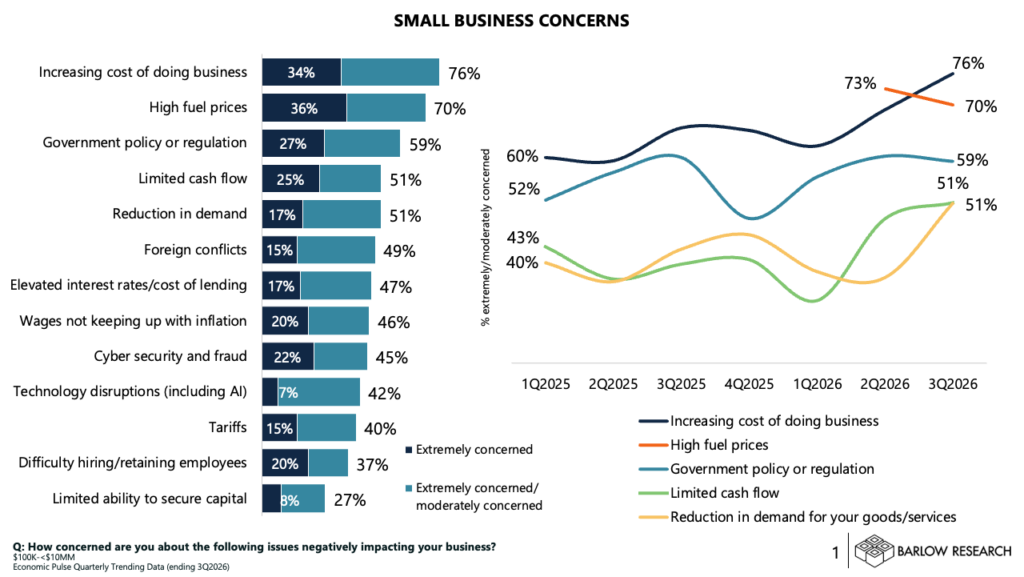
Confidence about the next 12 months also softened in the third quarter of 2026. Expectations about future sales, profits and excess cash reserves all weakened from the previous quarter, and four in ten small businesses now expect to fall short of their financial goals this year. Similarly, four in ten also expect to increase their prices (while only 3% expect to decrease their prices), signaling a concern about maintaining their margins going into 2027.
Demand for additional credit rebounded after reaching historically low levels earlier in the year. Small businesses are also modestly more likely to borrow in the next 12 months, with working capital and business growth serving as the primary reasons for expecting to seek financing.
Middle market outlook
Middle market companies delivered stronger financial performance during the third quarter compared to the small business segment. Overall financial conditions became healthier as improved sales helped offset continued pressure from elevated operating costs. However, net difference excess cash remains negative (there are more middle market companies with decreased rather than increased cash reserves), signifying further depletion of reserves.
Although financial performance improved, there are certainly middle market executives who remain cautious. As shown in the graph below, the increasing cost of doing business continues to be the leading concern (75% are extremely concerned or moderately concerned), while worries about wage growth, cybersecurity/fraud, high fuel prices and government policy remain elevated. With continued concern over higher operating expenses, general optimism is likely being tempering given the otherwise stronger sales expectations.
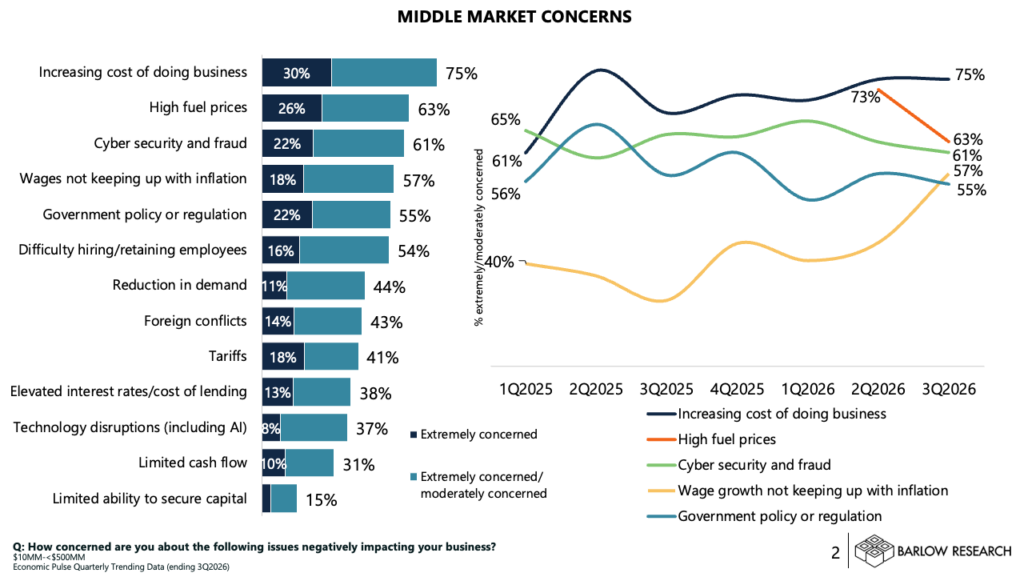
Financial condition optimism about the next 12 months remained relatively stable. Expectations for future sales strengthened considerably. However, many continue to anticipate elevated operating costs which temper profit expectations and broader optimism. While most companies still expect to meet or exceed their financial goals, expectations softened slightly. Middle market companies are optimistic but increasingly cautious which will likely force many to adopt a more measured approach toward growth.
Demand for additional credit increased during the third quarter. Credit availability continues to be favorable, with the overwhelming majority of applicants receiving either full or partial approval. Looking ahead, companies that plan to borrow continue to favor their primary bank and expect to use financing primarily for working capital or business growth.
Key takeaways
- Small businesses experienced weaker financial performance, driven by softer sales, declining profitability, shrinking cash reserves and growing concerns about slowing customer demand.
- Middle market companies improved financially, benefiting from stronger sales, although elevated operating costs continue to limit profitability and temper overall optimism.
- Demand for additional credit increased across both segments, creating opportunities for banks to provide working capital financing, liquidity management and advisory support as businesses balance growth with financial discipline.
For more information about this article, email Joel Mueller at jmueller@barlowresearch.com.