

Human-Validated Industry Intelligence Still Matters in an AI-Driven World
Guest authored by our friends at Vertical IQ

David Buffaloe
President
Vertical IQ
Posted: Mar 11, 2026
The rise of AI has transformed the way many professionals access and interpret information. Questions that once took hours of online research can now be answered almost instantly with a simple AI query.
But here’s an important reality check: Speed without substance, context, or verification can be risky. Especially in banking, lending, accounting, brokerage, and advisory work, where credibility and accuracy are non-negotiable, relying on AI alone simply isn’t enough.
The problem with ‘good enough’ data
Open-source AI platforms (like ChatGPT or Microsoft Copilot) work by synthesizing content that is available on the internet. It is sort of like a search engine on steroids, “learning” more as it works.
But as we all know, the internet can operate a bit like the Wild West: Anyone can post just about anything, whether or not it is true, relevant, or timely. As a result, much of the information open-source AI platforms “learn” from is general, incomplete, outdated, or even false. Relying on unvetted AI responses can result in not only issues with accuracy but also overlooking critical nuances that aren’t floating freely on the internet.
AI research is clearly good enough for some low-stakes situations: Maybe you want to create an itinerary for a seven-day trip to Wyoming in June, or you’d like a quick summary of action items from an internal meeting. But when a banker is evaluating credit risk on a plastics manufacturer or an advisor is helping a client navigate the acquisition of a new floral shop, “good enough” simply won’t suffice.
Business owners’ comfort, concerns with AI
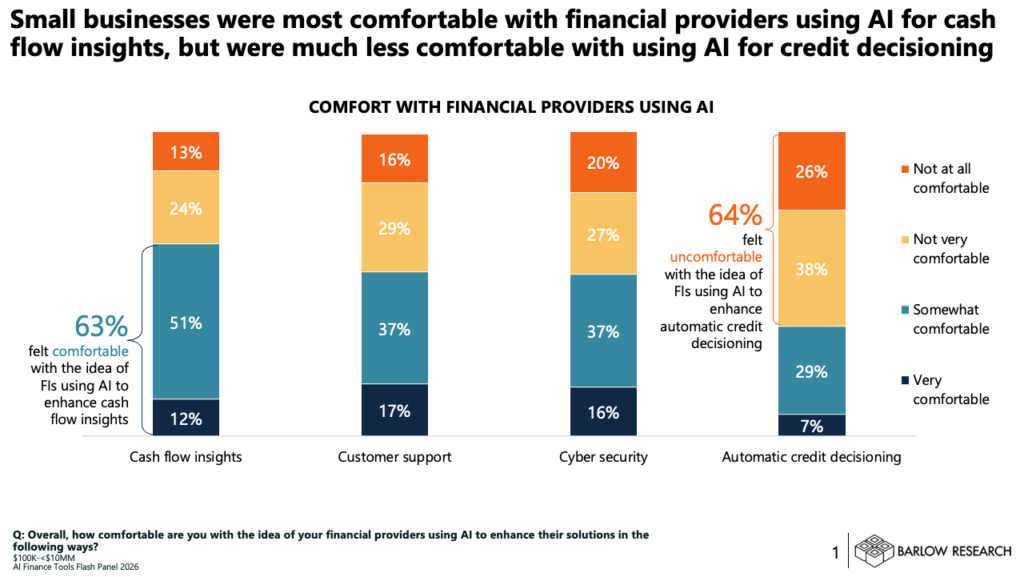
Recent Barlow Research data from February 2026 puts an even finer point on the topic: Business owners are apprehensive about their financial providers using AI for decision-making as well. For small business owners ($100K-<$10MM in sales), Barlow found that 63% felt comfortable with the idea of their financial institution using AI to generate cash flow insights, but a similar number (64%) were uncomfortable with the use of AI for automatic credit decisioning.
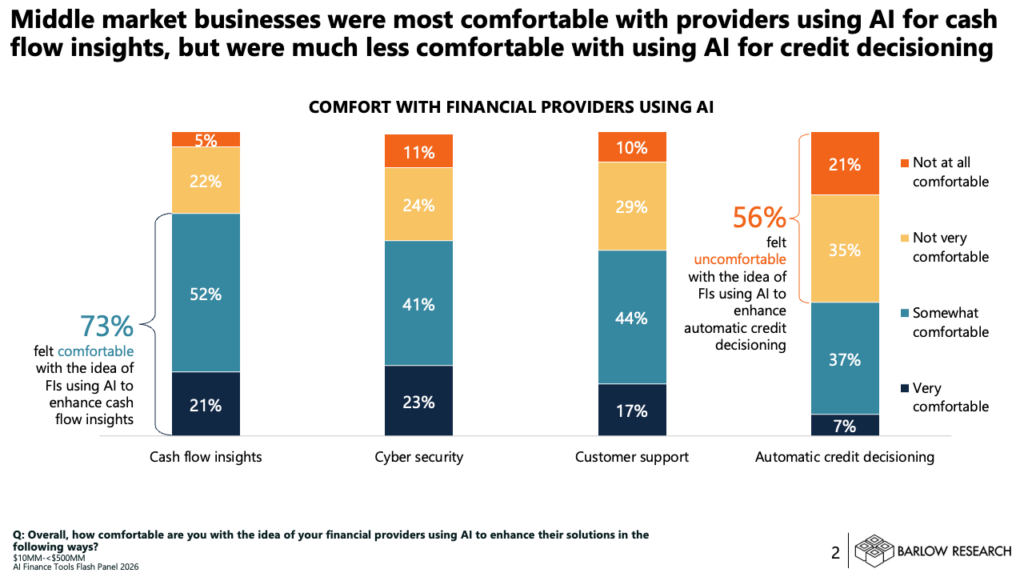
Middle market businesses ($10MM-<$500MM in sales) had similar feelings on the use of AI by their financial providers, per the Barlow data. While 73% said they were ok with AI being used by their financial institution to improve cash flow insights, more than half (56%) had apprehensions about automatic credit decisioning being done by AI instead of a human.
When surface-level information won’t suffice
The internet has made industry information more accessible than ever. With a quick search or AI prompt, anyone can produce a summary of nearly any sector in seconds. But professionals who work closely with businesses understand a key distinction: Having access to information isn’t the same as having access to Verified Industry Intelligence.
If you query different open-source AI tools, the responses are built from the same pool of publicly available internet content — aggregated from multiple sources, written for broad audiences, and sometimes outdated or unverified. Put another way: AI tools simply synthesize what already exists online, which means the output carries not only limitations but potentially liabilities. For professionals advising businesses or evaluating risk, that level of information simply isn’t adequate.
Bankers, lenders, and advisors are often making high-dollar decisions that affect credit exposure, client relationships, and long-term strategy. Whether preparing for a client meeting, evaluating a loan opportunity, or assessing a company’s financial outlook, open-source AI-generated industry summaries rarely provide the level of insight needed to make confident, well-informed decisions.
First, this type of unvalidated AI content lacks reliability. Much of the information circulating online (which open-source AI relies on) is not verified or designed for professional use. Purpose-built Verified Industry Intelligence, by contrast, incorporates licensed third-party data sources, structured datasets, and insights validated by experienced, human industry analysts. That process ensures professionals are working with information that is credible and decision-grade.
Another important difference is the relevance of the content AI is pulling from. Most industry content available online is written for investors or general business readers. It thus lacks the analytical insights and critical depth needed by financial professionals to understand an industry’s risks, revenue drivers, and opportunities. What’s more, it can be biased, dated, or taken out of context by AI tools, making it inadequate for advising business owner-clients. By using Verified Industry Intelligence, you can be confident your data is impartial, up-to-date, and salient.
Finally, some of the most valuable industry insights simply aren’t available through general internet searches. Organizations that specialize in Verified Industry Intelligence invest heavily in proprietary third-party data, experienced research teams, and continuously updated analysis designed specifically for professionals who require deeper context than what is available on the open internet.
Put simply: Anyone can look up an industry online or with open-source AI tools. But when the goal is to advise clients, evaluate risk, or guide critical business decisions, surface-level information isn’t enough, which is why Verified Industry Intelligence is more important than ever.
Human-validated intelligence is a necessity
Your clients and stakeholders depend on you for insights that go beyond generic summaries or AI-generated answers. They need focused, decision-grade data that’s timely, accurate, and grounded in real-world industry expertise in order to make informed decisions. This is where trusted, third-party, human-validated data becomes indispensable.
Unlike generic open-source AI outputs, curated, human-validated Industry Intelligence offers:
- Accuracy and trust: Content and data have been vetted by experts, not just scraped from the web.
- Timeliness: Information reflects the latest industry and economic conditions, not obsolete data figures or out-of-date reports.
- Depth and context: Nuanced insights like industry pain points, competitive dynamics, and financial benchmarks provide contextual subtleties that AI models alone often miss.
For bankers, your credibility is on the line every time you present insights or make a recommendation. Clients and key stakeholders expect you to know what’s around the corner, not just what’s already happened. Verified Industry Intelligence provides the foundation for that reliability and foresight.
AI is a useful tool to help you work faster; it’s not a substitute for trusted, human-vetted intelligence. Validated industry data ensures integrity, and in banking, accuracy matters.
In today’s business environment, clients rightly expect precision and expertise from the people who advise them. Professionals who combine the speed of AI with the reliability of expertly Verified Industry Intelligence will be the ones who stand out in the crowded marketplace and become a trusted advisor.
If accuracy matters to you, and you want to walk through a client’s door confidently every time, knowing you’re armed with timely information that’s been vetted and validated by a fellow human, then Verified Industry Intelligence is the answer. It provides you not only decision-grade insights but also peace of mind knowing that you are relying on the most up-to-date, accurate data available. And that is something AI alone may never “learn” to do!
About the Author
David Buffaloe is passionate about helping organizations leverage Industry Intelligence to make smarter, faster business decisions. He is president of Vertical IQ, where he leads company strategy and oversees research, marketing, customer success, product management, development, and HR. With more than 25 years of experience in SaaS and B2B technology, David specializes in aligning cross-functional teams to accelerate growth, enhance customer value, and scale operations.
About Vertical IQ
Headquartered in Raleigh, N.C., Vertical IQ is a nationally recognized leader in Industry Intelligence. Whether they’re discussing cash management with a local brewery or analyzing credit risk for a national biotech company, successful banks and credit unions use Vertical IQ to better understand a prospect’s or client’s business challenges before, during and after meetings. Covering 100% of the industries that comprise the U.S. economy and Canada, as well as 3,400 local economic reports, Vertical IQ equips users with the confidence and credibility to make memorable first impressions and sustain enduring relationships. Learn more at www.verticaliq.com.